

10-Step Munsell Neutral Gray Matte References $65.00
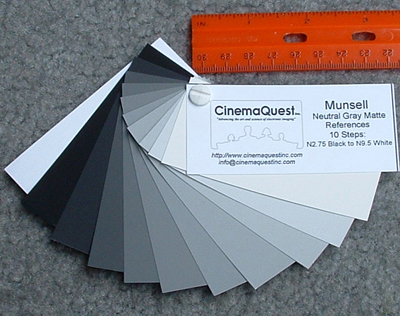
| Neutral | Reflectance |
|---|---|
| N 2 | 3.1% |
| N 2.75 | 5.5% |
| N 3.75 | 10.4% |
| N 4.75 | 17.6% |
| N 5.5 | 24.6% |
| N 6.25 | 33% |
| N 7 | 43.1% |
| N 7.75 | 54.8% |
| N 8.75 | 73.4% |
| N 9.5 | 90% |
Correct color perception in a video viewing environment is ideally enhanced and preserved by providing a neutral-colored surround within the field of view of a monitor's screen. Popular home theater magazines have consistently featured stylish viewing environments that look great with all the lights on. Unfortunately, these colorful design scapes tend to contaminate the image produced by the video display when it's time to watch a program. Rich colors near the screen skew the viewer's perception of the image on the display in a subtractive manner. Flesh tones can be perceived as slightly pink, green, yellow, blue, etc., depending on the color of the surround. Other picture elements, like grass and sky, can take on an unnatural hue that disrupts a sense of realism. The careful efforts of program producers and cinematographers to set a mood, via the subtle use of color, can be rendered ineffective. For these reasons SMPTE states that it is most critical that areas in the field of view be devoid of vivid colors. Similar problems occur in front projection theaters, even though they typically are used with no lights on. Light from the screen itself during bright scenes will illuminate the entire room. Tinted light will bounce back onto the screen when room surfaces or major furnishings are vividly colored. The ruling decor used in a front projection theater should be neutral or nearly neutral, and dark Some vividly colored accents can be used to add interest but should not dominate the room.
This fan deck is composed of 10 steps of gray, from flat white to flat black. It is a valuable tool in judging the choice of paints, fabrics and finishes to be used in designing the "ideal viewing environment". The Kodak 18% gray card has been recommended for years as a low-cost, visual reference for choosing materials used near direct-view TVs, rear projection big screens and flat panel displays such as gas plasmas and LCDs. This neutral value scale makes it easier to identify the suitability of more varied shades of gray decor. The gray card is equivalent to a Munsell notation of N 5. This Munsell Neutral Value Scale runs from a matte white notation of N 9.5 (90% reflectance) to a matte black notation of N 2 (3.1% reflectance). Each gray sample is 1 5/8" X 3 7/16"